Tape and Jointing vs Full Skimming: Which Plasterboard Finish Should You Choose?

Share
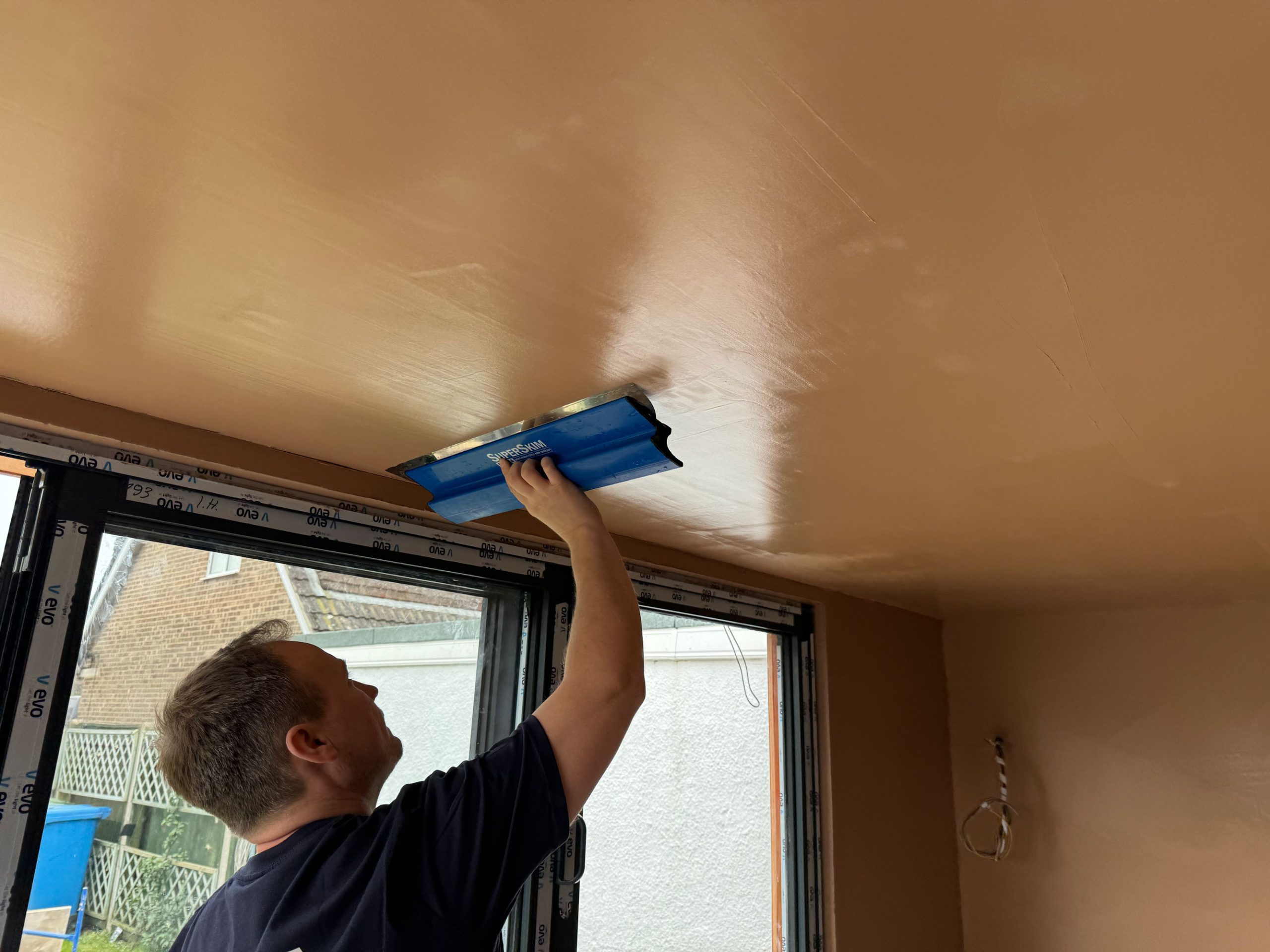
When finishing plasterboard walls and ceilings, two methods are commonly used: tape and jointing and full skimming.
Both create a surface ready for decoration, but they differ in how they’re applied, the finish they produce and the types of projects they’re best suited to. Choosing the right method depends on factors such as the build specification, required finish quality, budget, and programme.
In this guide, we’ll explain the differences between tape and jointing and full skimming, the advantages and disadvantages of each, and when one method may be more suitable than the other.
What Is Tape and Jointing?
Tape and jointing is a dry finishing method used to prepare plasterboard for painting or decorating without applying a full coat of finishing plaster.
Instead of covering the entire wall, only the board joints, internal corners, external corners and screw fixings are treated.
The process typically involves:
- Applying jointing compound over plasterboard joints
- Embedding paper or fibreglass joint tape
- Applying one or more finishing coats of compound
- Sanding the surface smooth once dry
The face of the plasterboard remains exposed, with only the joints being filled and feathered into the surrounding board.
Tape and jointing are widely used in modern housing developments, commercial fit-outs, and office interiors where speed and efficiency are priorities.

What Is Full Skimming?
Full skimming involves applying a thin coat of finishing plaster over the entire plasterboard surface.
Usually around 2-3mm thick, the skim coat creates a continuous, uniform finish that hides board joints and minor imperfections.
The process generally includes:
- Preparing the plasterboard
- Applying the first coat of finishing plaster
- Laying on a second coat
- Flattening and polishing the surface with finishing trowels
Once dry, the surface is ready for mist coating and painting.
Full skimming remains the preferred choice for many plasterers due to the exceptionally smooth finish it produces.
The Main Differences
Although both methods prepare plasterboard for decoration, there are several important differences.
| Feature | Tape & Jointing | Full Skimming |
| Finish | Joints blended into plasterboard | Entire wall covered |
| Application | Jointing compound only | Finishing plaster |
| Drying time | Faster | Longer |
| Labour | Lower | Higher |
| Material usage | Less | More |
| Surface quality | Very good | Excellent |
| Best suited for | Large developments, commercial work | Domestic homes, premium finishes |
Finish Quality
One of the biggest considerations is the quality of the finished surface.
A professionally completed tape and jointed wall can look excellent once painted. However, because the plasterboard face remains exposed, differences in texture can sometimes become visible under certain lighting conditions, particularly with darker paint colours or large windows creating raking light.
Full skimming creates a completely uniform plaster surface across the entire wall, making it easier to achieve a flawless painted finish.
For high-end residential projects or areas where lighting highlights imperfections, many plasterers still favour skimming.
Installation Speed
Tape and jointing is generally quicker.
Only the joints require treatment, reducing both application time and material usage. On large developments, this can significantly improve programme times.
Skimming requires:
- Mixing plaster
- Applying two coats
- Multiple trowelling stages
- Longer drying before decorating
Although experienced plasterers work quickly, skimming is typically more labour-intensive than tape and jointing.
Durability
Both systems are durable when installed correctly.
Tape and jointing rely on properly reinforced joints to minimise cracking as the building moves naturally over time.
A skimmed finish provides an additional continuous plaster layer across the entire surface, offering greater resistance to minor knocks and surface abrasion.
Neither system is immune to structural movement, but correct preparation is critical whichever method is chosen.
Decorating
Both finishes can be painted successfully.
Tape and jointed walls require careful priming to ensure the jointing compound and plasterboard absorb paint evenly.
Skimmed plaster also requires a mist coat before decorating, but because the entire wall has the same surface texture, paint often appears more consistent.

Cost Considerations
Tape and jointing generally offers lower installation costs due to:
- Reduced labour
- Less material
- Faster completion
For large-scale developments where hundreds of plots are being finished, these savings can be significant.
Full skimming costs more because it requires additional materials, greater skill and more time to complete.
Which Finish Is Better?
Neither method is universally better.
The right choice depends on the project requirements.
Tape and Jointing is often best when:
- Speed is important
- Budgets are tight
- Working on commercial projects
- Finishing large housing developments
- Decorating with lighter paint colours
Full Skimming is often preferred when:
- A premium finish is required
- Working in domestic properties
- Walls are likely to be viewed under strong natural light
- The highest quality decoration is expected
- Existing plasterboard has minor imperfections
Tools for Tape and Jointing
Achieving clean, consistent joints depends on using the correct tools.
Common tape and jointing tools include:
Using wider finishing knives helps feather compound over a greater area, reducing visible transitions once painted.
Tools for Full Skimming
Professional plasterers rely on several specialist tools throughout the skimming process.
These typically include:
- Stainless steel laying-on trowels
- Flexible finishing trowels
- Plastic finishing trowels
- Hawks
- Mixing drills
- Buckets
- Water brushes and spray bottles
Choosing the correct trowel at each stage helps reduce trowel lines and produces a flatter finish. To provide context & help with decision making, please read the following guide on How To Choose The Right Plastering Trowel for Every Stage of Skimming.
Can You Skim Over Tape and Jointing?
Put simply, yes. Many plasterers skim over previously taped and jointed plasterboard, provided the surface is sound and securely bonded.
Light preparation is usually required before applying finishing plaster, including cleaning the surface and removing any high spots. Skimming over tape and jointing is often carried out during refurbishments where a smoother, more uniform finish is desired.
Final Thoughts
Both tape and jointing, and full skimming, have an important place in modern construction.
Tape and jointing offers a faster, more economical solution for many commercial and large-scale residential projects, while full skimming remains the preferred choice where the highest quality finish is required.
Understanding the strengths of each method allows plasterers, dryliners and contractors to choose the most appropriate system for the project, balancing finish quality, programme and budget.
For more practical guidance on plasterboard finishing, explore our related guides covering different skimming techniques and how to choose the right plastering tools for each stage of the process.
How To Choose The Right Plastering Trowel for Every Stage of Skimming
The Ultimate Guide to Plastering Tools for Different Jobs
Flexible Finishing Trowels: An In-Depth Comparison & Buying Guide