Venetian Plaster vs Microcement: Understanding the Differences

Share

Decorative wall and surface finishes can transform an interior, providing both a distinctive appearance and a durable alternative to conventional painted or tiled surfaces. Two finishes that are increasingly associated with high-end residential, hospitality and commercial interiors are Venetian plaster and microcement.
Although both can create smooth, seamless-looking surfaces with a premium appearance, they are different materials with different characteristics and typical applications. Venetian plaster is traditionally associated with lime-based decorative plaster containing fine marble or mineral aggregates. It is applied in multiple thin coats and can be polished to create surfaces ranging from subtle matt finishes to highly polished, marble-like effects.
Microcement is a thin cementitious decorative coating modified with polymers and other additives. It is generally installed as part of a complete system and can be used on walls and, where the specific product is designed for the application, floors, bathrooms and other interior surfaces. The two finishes can therefore produce similarly sophisticated results while offering different practical and aesthetic characteristics.
Choosing between Venetian plaster and microcement depends on factors such as the substrate, location, expected level of wear, exposure to moisture, desired appearance, maintenance requirements and the manufacturer’s system specification.
In this guide, we’ll compare Venetian plaster and microcement, explain where each finish is typically used and look at the specialist tools that can help achieve a professional decorative finish.
Comparison of Materials, Application Techniques and Finished Appearance
Venetian Plaster
Venetian plaster is a decorative plaster finish traditionally made using lime and fine mineral aggregates such as marble dust, although modern formulations can vary. The material is normally applied in several thin coats. Each layer can be worked and refined using a specialist trowel, gradually building the depth and character of the finished surface.
One of the defining features of Venetian plaster is its visual depth. The interaction between multiple thin layers can produce subtle variations in colour, movement and reflection that are difficult to reproduce with a conventional painted finish.
Depending on the product and application technique, Venetian plaster can produce:
- Matte or lightly textured surfaces
- Satin finishes
- Burnished finishes
- Highly polished surfaces
- Marble-like decorative effects
The final appearance is heavily influenced by the skill and technique of the applicator. Trowel pressure, direction, material thickness and polishing technique can all affect the finished surface.
Microcement
Microcement is a cementitious decorative coating modified with polymers and other additives. It is designed to be applied in relatively thin layers as part of a complete system. Depending on the manufacturer, the system may include primers, base coats, reinforcement, decorative coats and a protective sealer.
Microcement is often associated with a more contemporary architectural appearance. It can create surfaces inspired by concrete, natural stone or other mineral finishes, with subtle variations resulting from the application technique.
Depending on the product and finish selected, microcement can provide:
- Matt surfaces
- Satin finishes
- Lightly textured surfaces
- Smooth contemporary finishes
- Concrete-inspired decorative effects
Like Venetian plaster, the final appearance depends on the applicator’s technique. Consistent application, careful trowelling and appropriate finishing are important for achieving a uniform result.
Venetian Plaster vs Microcement: At a Glance
| Feature | Venetian Plaster | Microcement |
| Material | Traditionally lime-based with fine mineral aggregates | Cementitious, polymer-modified decorative coating |
| Typical use | Internal walls and ceilings | Walls, floors and other surfaces depending on system |
| Appearance | Polished, marble-like, layered and decorative | Contemporary, mineral, concrete or stone-like |
| Application | Multiple thin decorative coats | Multiple thin coats as part of a complete system |
| Finish | Matt, satin or polished | Matt, satin, textured or polished |
| Visual depth | Often pronounced due to layered application | Generally more understated and uniform |
| Floor applications | Generally unsuitable for normal floor traffic | Suitable where specifically designed for flooring |
| Wet areas | Product dependent and generally requires appropriate protection | Can be suitable where the complete system is specified for wet areas |
| Durability | Durable decorative wall finish when correctly applied | Hard-wearing when correctly specified and sealed |
| Maintenance | Generally straightforward with suitable cleaning methods | Generally low maintenance when correctly sealed |
The precise characteristics of both materials vary between products. The manufacturer’s technical information should always be checked before specifying a finish.
Typical Internal Applications and Substrate Suitability
The suitability of Venetian plaster or microcement depends not only on the desired appearance but also on the surface being treated and the conditions it will experience.
Where Is Venetian Plaster Typically Used?
Venetian plaster is primarily used for decorative internal walls and ceilings.
It can be particularly effective in areas where the finish itself is intended to become a prominent design feature, including:
- Feature walls
- Living rooms
- Bedrooms
- Hallways
- Stairwells
- Reception areas
- Restaurants
- Hotels
- High-end residential interiors
- Decorative fireplace surrounds
Venetian plaster can be particularly effective where a luxurious, traditional or natural mineral appearance is required.
The substrate should be suitably prepared before application. It should be sound, clean, dry and sufficiently flat for the specified decorative system.
This is particularly important because highly polished finishes can highlight imperfections in the surface beneath them.
Where Is Microcement Typically Used?
Microcement is used across a broader range of internal applications, subject to the manufacturer’s specification.
Depending on the system, applications can include:
- Internal walls
- Floors
- Bathrooms
- Shower areas
- Kitchens
- Utility rooms
- Hallways
- Staircases
- Commercial interiors
- Retail spaces
- Hospitality environments
One of the advantages of microcement is that it can provide a visually continuous surface across different areas of an interior.
However, the substrate must still be suitable and correctly prepared. Existing tiles, plaster, plasterboard, concrete and other surfaces may be suitable for particular systems, but this should never be assumed.
The substrate must be stable and any movement, moisture problems, loose material or significant cracking should be addressed before the decorative coating is applied.
Substrate Preparation
Good substrate preparation is essential for both finishes.
Neither Venetian plaster nor microcement should be regarded as a method of hiding an unsuitable substrate.
Before application, the surface should be assessed for:
- Cracking
- Movement
- Moisture
- Contamination
- Loose material
- Uneven areas
- Previous coatings
- Compatibility with the specified system
The manufacturer’s preparation requirements should always be followed.
For microcement in particular, the complete system should be considered. Primers, reinforcement, base coats and protective sealers may all form part of the required build-up.
Specialist Tools Required for High-Quality Decorative Finishes
The quality of a decorative finish depends on several factors, including material selection, substrate preparation, application technique and the tools used.
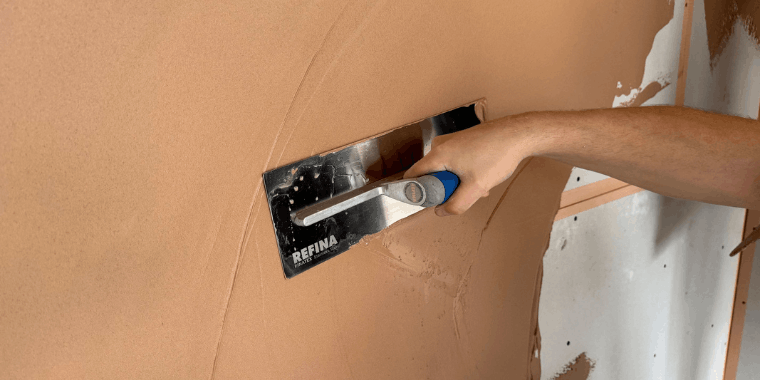
A specialist polishing trowel can provide greater control when applying and refining thin decorative materials such as Venetian plaster and microcement.
Unlike a general-purpose plastering trowel, a decorative polishing trowel is designed to provide the control needed for thin coats and finishing work.
REFINA polishing trowels feature polished stainless-steel blades with carefully formed edges and corners designed to help reduce drag lines during application and finishing.
Different blade sizes, shapes and flexibilities are available to suit different decorative applications.
For Venetian plaster, the trowel needs to allow the applicator to spread thin coats evenly before progressively refining and polishing the surface.
For microcement, the tool needs to provide sufficient control to apply and work the material consistently while minimising unwanted marks.
The REFINA FINATEX range and specialist polishing trowels can be used across decorative plastering applications, while dedicated polishing trowels are available for Venetian plaster and microcement work.
When choosing a specialist decorative trowel, consider:
- Blade size
- Blade flexibility
- Blade profile
- Edge design
- Corner radius
- Handle comfort
- Material being applied
- Desired finished effect
- Size and complexity of the surface
The right tool does not replace good application technique, but it can provide greater control and help the applicator achieve a more consistent finish.
Key Considerations When Choosing Between Venetian Plaster and Microcement
There is no universally better finish between Venetian plaster and microcement. The right choice depends on the requirements of the individual project.
Desired Appearance
Venetian plaster is generally the stronger choice where the objective is a highly decorative, layered or marble-like appearance. Microcement is often preferred where a more contemporary, minimalist or architectural finish is required.
Location
Consider where the material will be installed.
Venetian plaster is primarily suited to internal walls and ceilings, while certain microcement systems can be used across walls, floors and other surfaces.
Level of Wear
The expected level of traffic and physical wear should also be considered.
For decorative walls, Venetian plaster can provide a durable finish when correctly applied and maintained. For floors and other high-traffic surfaces, a microcement system specifically designed for that application may be more appropriate.
Moisture Exposure
Moisture is another important consideration. Some decorative plaster systems can be used in areas exposed to limited moisture, but the suitability depends on the individual product.
Microcement systems can be specified for bathrooms and other wet areas where the complete system has been designed for that application.
Importantly, a decorative coating should not automatically be considered a substitute for waterproofing. In wet rooms and shower areas, the substrate, waterproofing system, decorative coating and protective sealer all need to be considered together.
Substrate
The existing surface can influence which finish is most practical. Assess the substrate before choosing a material and confirm that the complete system is compatible with it. Existing movement, cracking or moisture problems should be resolved before applying a decorative finish.
Maintenance
Both finishes can be relatively low maintenance when correctly installed. Venetian plaster may require more careful cleaning depending on its formulation and protective finish.
Microcement can provide a continuous surface with minimal joints, potentially making it straightforward to maintain. However, cleaning products should always be compatible with the protective sealer.
Application Skill
Neither finish should be regarded as a simple DIY coating. Both require careful preparation and application, and the final appearance can be significantly affected by the applicator’s technique.
Venetian plaster in particular relies heavily on the ability to build and polish multiple thin coats to create the desired decorative effect.
Microcement also requires consistency across the complete system to avoid visible variations, excessive trowel marks or differences in texture.
Venetian Plaster vs Microcement: Which Should You Choose?
Venetian plaster and microcement can both provide high-end decorative finishes, but they serve different purposes. Venetian plaster may be the better option when the priority is:
- A luxurious decorative finish
- Marble-like or polished effects
- Visual depth and tonal variation
- Feature walls
- Internal walls and ceilings
- A traditional or mineral aesthetic
Microcement may be more appropriate when the priority is:
- A contemporary minimalist appearance
- A continuous decorative surface
- Internal floors
- Bathrooms and wet areas where the complete system is suitable
- High-traffic surfaces
- Concrete or stone-inspired aesthetics
- A versatile decorative system for refurbishment projects
The decision should ultimately be based on the complete project specification rather than appearance alone.
Consider the substrate, location, expected wear, moisture exposure, desired finish, maintenance requirements and manufacturer’s application guidance before selecting the system.
Whichever material is chosen, correct preparation, suitable tools and professional application are essential for achieving a high-quality decorative finish.
For professional applicators, selecting the correct trowel can also make a significant difference. A specialist polishing trowel provides the control needed to work thin decorative materials and refine the finished surface.
For more practical guidance on selecting the right tools for plastering and decorative finishing projects, explore our related REFINA guides:
- The Ultimate Guide to Plastering Tools for Different Jobs
- The Complete Guide to Plastering Trowels: Skimming Walls, Finishing Coats & Choosing Flexible vs Rigid Blades
- How To Choose The Right Plastering Trowel for Every Stage of Skimming
- Flexible Finishing Trowels: An In-Depth Comparison & Buying Guide